Vote Nevada Supporters,
Women’s Empowerment Month update:
The CSN Women’s Alliance hosted a Breaking Barriers: Affordable Childcare Zoom meeting Friday. We heard about some interesting new approaches to providing affordable childcare. You can watch the recording here:
https://vote-nevada.news/WA-Affordable-Childcare
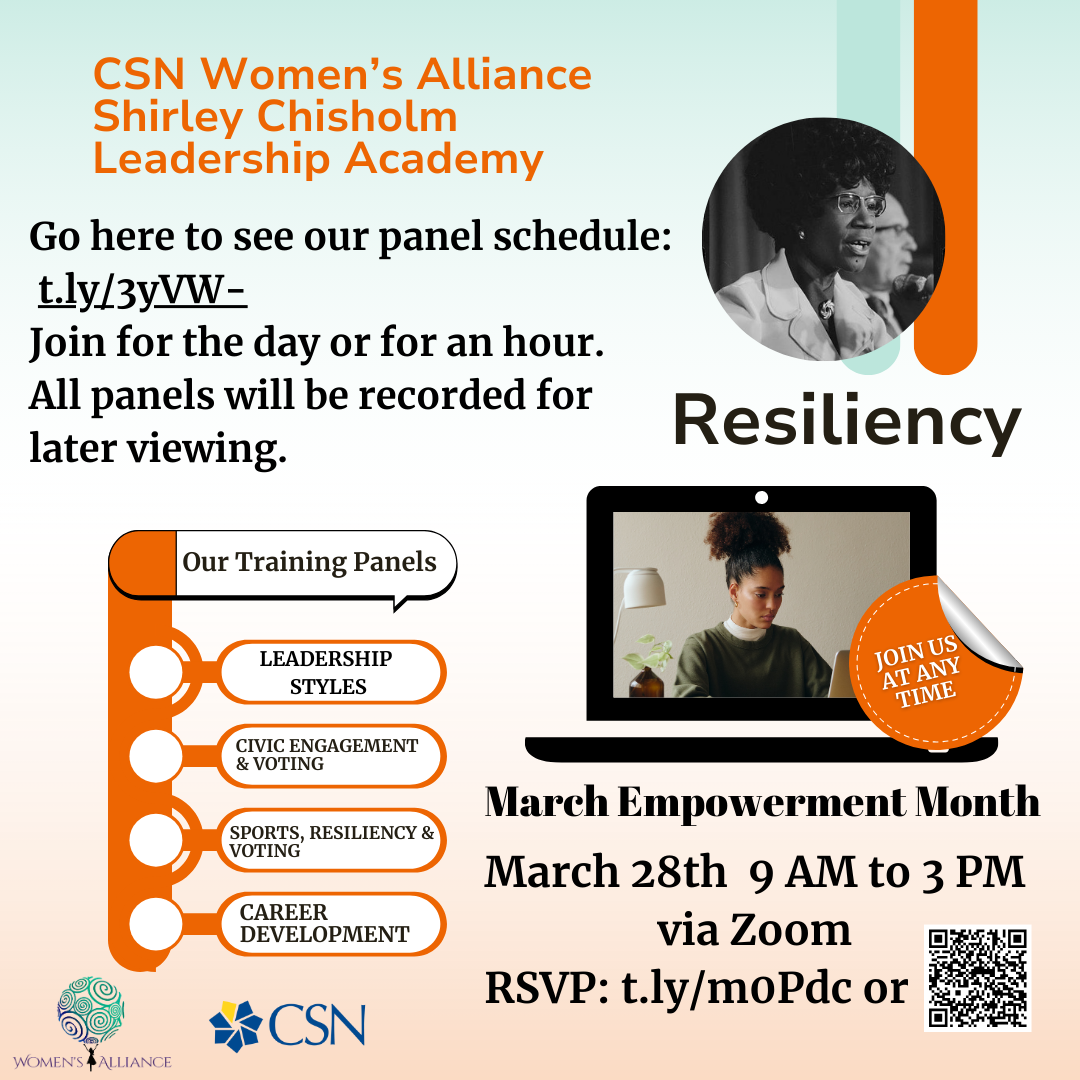
Please also consider attending the CSN Women’s Alliance Shirley Chisholm Leadership Academy on March 28th. We will be on Zoom from 9 AM to 3 PM, with a new panel starting at the top of every hour. Resilient leadership is our theme this year. You can RSVP through the link below and will receive one Zoom link you can use the whole day:
https://us02web.zoom.us/meeting/register/u5OO29pwQe6ZvW999ioIpw#/registration

Legislative update:
Week five of the legislative session just concluded. A federal sword is still hanging over our state budget due to uncertainty in the courts and Congress, so most of the legislative bills heard up to now have been evaluated for their policy content. Bills requiring money are waiting for news on federal funding, but legislative committees can only wait so long to address fiscal notes.
The regular session runs for just 120 calendar days, so bills must meet deadlines to stay viable. While some bills are deadline exempt and some that die may receive a reprieve and get a second life by leadership, in general, if a bill doesn’t advance fast enough, it’s dead for this session.
You can view the 120-day calendar here https://www.leg.state.nv.us/Session/83rd2025/Docs/120-day_calendar.pdf
It’s possible we may need a brief special legislative session after the regular session if federal funds are still frozen, but hopefully that won’t be necessary because special sessions are expensive.
We’ve had one high-intensity joint-committee meeting of Health and Human Services on Wednesday, February 26th, to hear about the possible federal Medicaid cuts.
You can watch the hearing here https://sg001-harmony.sliq.net/00324/Harmony/en/PowerBrowser/PowerBrowserV2/20250226/-1/16779?mediaStartTime=20250226160442&mediaEndTime=20250226185711&viewMode=3&globalStreamId=4
The information provided was shocking due to the high number of Nevadans on Medicaid.
Medicaid is the health insurance program states offer with federal help for low-income and some disabled individuals. Roughly 800,000 Nevadans are covered by Medicaid, and approximately 368,000 could lose coverage if federal budget cuts happen.
https://thenevadaindependent.com/article/nevada-republican-gov-lombardo-speaks-out-against-gops-proposed-medicaid-cuts
https://www.kff.org/medicaid/issue-brief/eliminating-the-medicaid-expansion-federal-match-rate-state-by-state-estimates/
This means we have thousands of Nevadans who are working full-time yet lack an employer-funded health insurance benefit and who also do not make enough to afford private health insurance.
According to an article in The Nevada Current:
“The number of employees of large companies and their dependents who are eligible for Medicaid has risen in recent years — from 261,151 in fiscal year 2019 to 376,597 in fiscal year 2023.”
https://nevadacurrent.com/2024/01/24/amazon-walmart-remain-atop-list-of-companies-with-most-employees-on-nevada-medicaid/
The Medicaid expansion in 2012 under Governor Brian Sandoval helped many Nevadans, but now it is masking the fact that some major businesses and government agencies fail to offer health care coverage while paying their workers too little to purchase their own health insurance.
From this fact, it’s logical to assume that many Nevadans are living close to the poverty line and can’t absorb even a slight economic shockwave. If this is true, Nevada’s economy is not as strong as we assume. Teetering on the edge of a cliff makes a person unsafe, just as an economy teetering on the edge of a recession is unsafe.
Are there other signs that the economy is weak?
Coming out of the pandemic, Nevada’s economy was robust to the point where inflation made high prices a campaign issue in 2024. The high cost of housing, food, gas, car insurance, childcare, and medical treatment were all topics of concern in last year’s election.
Pandemic relief money spending provides additional evidence that many families felt the need to spend the extra money in their bank accounts in 2023 and 2024. Financially stable households save surplus funds, while vulnerable families with unmet needs spend extra money.
We heard policy ideas from candidates in both parties that would supposedly bring prices down or create new and better paying jobs. Post-election, however, it appears federal Republicans are focused on tariffs and cutting federal jobs, while the Democrats are busy highlighting the cuts to federal subsidies that sustain programs such as Medicaid.
The choice for many Nevadans, therefore, continues to be either living on the edge of poverty with government support or without government support as they struggle with high prices for housing, food, gas, car insurance, childcare, and medical treatment.
Many groups and organizations are working to increase wages, provide more affordable services, and offer pathways to lucrative employment. And these efforts help Nevadans in some areas, yet we lack a person or office that can execute a comprehensive workforce development plan that addresses systemic issues that keep people in poverty.
To create and implement a comprehensive workforce development plan that addresses systemic issues we need governing processes that can manage a heavy lift. So, step one, if we want systems level change, we must communicate to elected leaders that this is a community supported goal, and then, second, we must determine legislative capacity to do the heavy lift required to change our workforce plan.
To succeed, community members must come together, arrive at consensus on outcomes, and then measure those outcomes against the legislature’s capacity to address larger issues. For instance, do we want our legislators to develop a workforce plan that can transition Nevadans into higher-wage skilled jobs, or would we like our legislature to create a position or consolidate administrative power into an existing office to oversee building a better and more comprehensive workforce ecosystem?
It’s very likely people already exist in multiple offices, agencies, and boards who focus on discrete parts of workforce development, so we just need someone to help coordinate between those offices, boards, and agencies.
This happened in 2023 with Assembly Bill 37. Through the bill the legislature gave Nevada System of Higher Education funding and instructions to create a statewide mental and behavioral health workforce development program.
With the capacity needed to do the job, the legislature instructed NSHE to implement a comprehensive workforce development plan. Based on those instructions, the legislature now provides NSHE funding to coordinate with everyone working in the behavioral and mental health workforce space.
An example of this process in the current legislative session is Assembly Bill 339, which creates the Office of Children’s Mental and Behavioral Health within the Office of the Director of the Department of Health and Human Services. This office will coordinate the whole children’s mental and behavioral health system.
We need more of this type of thinking, so Vote Nevada is tracking workforce related bills this legislative session through our Nonpartisan Caucus. After the legislative session ends, we plan to review which bills passed and ask which bills improved workforce development and good governance.
The next step will be creating a citizens interim committee to discuss what we would need to create and implement a comprehensive workforce development plan. The committee could make recommendations for bills in the 2027 legislative session or possible ballot questions in the 2026 election cycle.
Thank you for being Nevadans with me,
Sondra
Vote Nevada is now qualified to receive donations through Smith’s Inspiring Donations; you can read more about how to donate to Vote Nevada each time you use your Smith’s loyalty card here https://www.smithsfoodanddrug.com/i/community/smiths-inspiring-donations
Vote Nevada is a 501(c)(3) nonprofit civic engagement organization. Anyone can become a supporter by emailing info@vote-nevada.org; we have no membership dues.
You can now donate to Vote Nevada through PayPal at https://www.paypal.com/donate/?hosted_button_id=L423L7FBMMBEA


 Vote Nevada