Tag Archives: history

Vote Nevada PAC Submits Two New Ballot Questions

Vote Nevada PAC filed two new ballot questions today in response to the legal challenge to our independent redistricting commission initiative. Both ballot questions are now on the SOS website: https://www.nvsos.gov/sos/elections/2026-petitions 

The Nevada Constitution grants every Nevadan the right to run and vote on ballot questions; failing to empower every Nevadan to exercise that right puts it in grave danger.  Our constitutional amendment ballot question, therefore, reverses the latest interpretation of Section 6, thereby lessening that danger.

The first ballot question directly addresses the 2022 Nevada Supreme Court ruling that drastically re-interpreted Article 19, Section 6 of the Nevada Constitution, which is cited in the legal challenge.  Until 2022, the legal interpretation of Section 6 matched the plain language interpretation: It only applied to statutory and statutory amendment ballot questions.  

Here is Article 19, Section 6:

Sec. 6.  Limitation on initiative making appropriation or requiring expenditure of money.  This Article does not permit the proposal of any statute or statutory amendment which makes an appropriation or otherwise requires the expenditure of money, unless such statute or amendment also imposes a sufficient tax, not prohibited by the Constitution, or otherwise constitutionally provides for raising the necessary revenue.

In the 2022 Education Freedom PAC v. Reid ruling, our state Supreme Court decided that Section 6 also applied to constitutional amendment ballot questions.  No one has ever used that interpretation, dating back to the addition of Section 6 to the Nevada Constitution in 1972.

Consequently, anyone can now challenge a constitutional amendment ballot question and claim, not prove, that the ballot question’s outcome will require an expenditure of public funding.  And solely based on that claim, the court can require ballot question sponsors to put tax laws in the Nevada Constitution to pay for hypothetical expenditures.  

It takes at least five years to amend the Nevada Constitution, so how exactly can someone accurately estimate the cost of something new and then craft a tax or tax increase that will withstand the constant fluctuations in our economy?  It is impossible. 

If this wasn’t bewildering enough, it has also become very apparent that the Reid ruling is not being applied uniformly to all constitutional amendment ballot questions.  Two constitutional amendment ballot questions were on our 2024 ballot and will also appear on our 2026 ballot, which will likely require an expenditure of state funds for at least administrative costs. 

Yet, neither Ballot Question 6 nor Ballot Question 7 includes revenue-generating taxes.  What is the difference between our ballot question and these questions?  The only difference is that no one sued to force these ballot question sponsors to add a taxing mechanism to their constitutional amendment ballot questions.

The Fourteenth Amendment of the U.S. Constitution gives every American the right to equal protection under the law.  This is clearly not happening in Nevada with the new requirement to include taxing mechanisms in constitutional amendment ballot questions.  Instead, Nevadans are being subjected to different standards and treatment by the state, depending on the actions of the political parties and special interest groups.

If the political parties and special interest groups like your ballot question, the state gives you a free pass to avoid unfunded mandate requirements.  But if the political parties or special interest groups dislike your ballot question, then your initiative is pulled into court to trigger the state to enforce the taxation requirement. 

Furthermore, upon reviewing all the information about ballot questions on the Nevada Secretary of State’s website, there is not a single mention of Article 19, Section 6, nor is there any reference to the Reid ruling requirements. How is the average Nevadan supposed to know about the new revenue-generating taxation requirement to ensure they put taxes into our state constitution when running a ballot question?

We clearly now have a two-tiered system for direct democracy in our state.  One tier for Nevadans who can hire attorneys to manage their ballot initiatives, and one for Nevadans who represent themselves and so cannot afford to hold government and powerful people accountable.  

Our second ballot question is also a constitutional amendment. We must ensure that every Nevadan is treated equitably and fairly in the redistricting process.  Nonpartisan voters must be entitled to the same rights and protections as all voters, regardless of their political affiliation.  The political parties should have no power to silence any Nevadan through rigged redistricting maps. 

The second ballot question, therefore, adds this language to our existing Voter Bill of Rights: 

(All eligible voters have a right:) To have equal rights and treatment in all aspects of representative government without regard to political party affiliation, including, but not limited to, processes that determine representation through apportionment and redistricting.
Vote Nevada PAC Statement of Ballot Question Withdrawal

It is with great disappointment that Vote Nevada PAC announces the withdrawal of our Independent Redistricting Commission ballot initiative, which aimed to bring redistricting into the open with legal accountability and transparency. 

We wanted Nevadans working with legislative leaders to draw district maps after each census, in open meetings, and with the focus on fair representation.  

Once again, however, the Nevada Democratic Party is using a misguided Nevada Supreme Court ruling to not only endorse the current, behind-closed-doors, and therefore corrupt redistricting process, but also to eliminate our right to amend the state constitution through the initiative process.

Suing to silence the voices of the people may be a smart political strategy, but it ultimately undermines democracy.  Both parties should review this country’s history to be reminded that neither is entitled to use apportionment to accrue power that puts donors over voters. 

In the legal complaint against our ballot initiative, see attached, the Democratic Party argues that we must place taxes in the Nevada Constitution when running ballot initiatives that amend the state Constitution and may cost even $1 in state funds.

Putting taxes into the Constitution is an irresponsible and ludicrous proposition. Nevadans are well aware of the issues we face because our mining tax is enshrined in the state Constitution. Based on that experience, we would never believe that putting more taxes in our Constitution is a sound idea. 

This argument comes from a 2022 Nevada Supreme Court ruling that re-interpreted Article 19, Section 6 of the Nevada Constitution, which states:

Sec. 6.  Limitation on initiative making appropriation or requiring expenditure of money.  This Article does not permit the proposal of any statute or statutory amendment which makes an appropriation or otherwise requires the expenditure of money, unless such statute or amendment also imposes a sufficient tax, not prohibited by the Constitution, or otherwise constitutionally provides for raising the necessary revenue(Emphasis added)

The words “statute” and “statutory,” which have unambiguous definitions in the English language, (a written law passed by a legislative body) are the only two identifiers included. However, in the 2022 Education Freedom PAC v. Reid ruling, the Court interpreted Section 6 to mean statutory AND constitutional (a body of fundamental principles or established precedents according to which a state or other organization is acknowledged to be governed) amendment ballot initiatives. 

A plain language reading of this Section does not include constitutional amendment ballot questions, yet, because of this misguided interpretation, Nevadans are now, for all intents and purposes, blocked from exercising our constitutionally granted right to propose changes to the state Constitution that may expend even $1 in state funds. 

Lacking guidance from the Court or anyone else, we have no clear understanding of how to incorporate tax law into Nevada’s Constitution.   

Even if that guidance existed, we refuse to put taxes into our state Constitution, so our only course of action to restore our right to propose constitutional amendments through the initiative process is to amend our state Constitution to clarify its original meaning in Article 19.

The current misguided interpretation of this critical right cannot be allowed to remain unchallenged.

We are exploring the most effective way to move forward by addressing this error in a way that does not cause the Democratic Party to sue once again to silence us, so please stay tuned.

Sondra Cosgrove

Doug Goodman

Claire Thomas

You can refer back to our history of redistricting reform in Nevada here: Brief redistricting reform history in Nevada

You can read the lawsuit filed against me, Doug, and Claire here: 2025-09-29-Complaint-1 


Vote Nevada Ballot Questions Information

Vote Nevada Supporters,

I want to share background information on the two ballot questions we filed today with the Secretary of State’s office.  Below you will find a link to the Secretary of State’s Ballot Petitions website as well as the very detailed press release, which we put out for the news media.  If you have any questions, please feel free to contact me.

Sec. of State Ballot Petitions: https://www.nvsos.gov/sos/elections/2026-petitions

FOR IMMEDIATE RELEASE 

Refer to the link at the end for background information and essential details.

On September 9, 2025, Vote Nevada PAC exercised our state constitutional right to amend Nevada’s constitution through the ballot question process.  This right is under threat and must be protected and preserved. 

We refiled the independent redistricting commission ballot question as it was filed in 2020, 2022, and 2024.

Nevada’s redistricting process is plainly corrupt and must be put into alignment with Nevada’s transparency and accountability laws.

We are not proposing a nonpartisan redistricting commission; instead, we support a balanced commission with Democrats, Republicans, and non-major-party Nevadans.  Currently, while nonpartisan and third-party voters comprise just under 43% of registered voters, nonpartisan and third-party elected representatives comprise 0% of our legislature. 

The proposed commission, therefore, aligns with the U.S. Constitution’s guarantee of representative government and provides a seat at the table for all Nevadans.

Our redistricting commission will be independent of our legislative redistricting process. This is key to our proposal.  Currently, our legislature exempts itself from Nevada’s Open Meeting Law and Public Records Act, which means it exempts itself from transparency and accountability. 

Consequently, legislators draw the people’s redistricting maps behind closed doors, blocking the public’s right to know who is enabling Nevada’s politicians to pick their voters.  This is an indefensible, corrupt process that must change.

If our legislators were interested in addressing this corruption, the legislative majority could have heard and passed AJR5 in the 2025 legislative session, yet the bill failed to receive even a hearing.  Assemblywoman Kasama’s bill proposed amending the Nevada Constitution to put redistricting under our Open Meeting Law and Public Records Act.

Our ballot question also limits redistricting to the 180 days following the release of the Census, so there will be no mid-cycle redistricting.  This obviously addresses the partisan nonsense in the news right now.

Our amendment transfers existing funding for redistricting from the legislative process to the independent redistricting commission, which is similar to Ballot Question 6 and Ballot Question 7 from 2024.  Neither of those ballot questions includes a taxing mechanism despite expending state funds due to the presumption that current state funding can be used to implement those two amendments.

This proposed amendment also utilizes the exact wording of Senate Joint Resolution 6 from the 2025 Nevada legislative session. As a legislative resolution, it was written by the Legislative Counsel Bureau, which comprises attorneys who write legislation; therefore, our ballot question meets all current legislative legal qualifications.

To further strengthen the rights of voters, we will also fill a second, related ballot question.

Second Ballot Question: Reduce Barriers to Primary Voting

Currently, we have segregated primary elections where members of the two major private political organizations exclude non-party members from participating in their closed, taxpayer-funded primaries.

We must ensure every eligible voter can make their voice heard in every taxpayer-funded election.   The two major private political parties do have a protected right of association, but they do not have a right to force taxpayers to pay for their internal nominating functions.

This problem is happening even though in 2020 Nevadans put a Voter Bill of Rights in our constitution, which states that all eligible voters have a right:

  1. To equal access to the elections system without discrimination, including, without limitation, discrimination on the basis of race, age, disability, military service, employment or overseas residence.

https://www.nvsos.gov/sos/elections/voters/voters-bill-of-rights

To clarify this right, we are filing a second ballot question to add the right to equal participation in all taxpayer-funded elections regardless of political affiliation to our state constitution’s Voter Bill of Rights. 

  1.   To fully participate in all publicly funded elections without limitation, including, but not limited to, any requirement to affiliate with any private organization, such as a political party.

Political parties can engage in privately funded nominating processes if they so desire.  For example, in 2024, the Nevada Republican Party ran a private caucus in the presidential preference primary, and the national Democratic Party hosted a private Zoom meeting to select Kamala Harris.

In closing: 

In 2024, both political parties advised voters not to support Ballot Question 3 because the BQ3 campaign had received outside funding.  They did this knowing it is almost impossible to pass a ballot question without millions of dollars, which is why their preferred ballot questions (6 & 7) also received outside funding.

Vote Nevada is comprised of Nevadans with no outside funders; we simply need the opportunity to speak to our fellow Nevadans to try to pass necessary democracy reforms.  If either of the political parties sues to stop us so they can maintain control of our democracy, the parties will win, and we will lose our right to fix what the parties have broken. 

History of Redistricting Reform in Nevada

 Thank you for being a Nevadan with me,

 Sondra

Vote Nevada is now qualified to receive donations through
Smith’s Inspiring Donations; you can read more about how to donate to Vote Nevada each time you use your Smith’s loyalty card here https://www.smithsfoodanddrug.com/i/community/smiths-inspiring-donations

Vote Nevada is a 501(c)(3) nonprofit civic engagement
organization.  Anyone can become a supporter by emailing info@vote-nevada.org;
we have no membership dues. You can now donate to Vote Nevada through
PayPal at  https://www.paypal.com/donate/?hosted_button_id=L423L7FBMMBEA


Vote Nevada Update: 5/22/2025

Vote Nevada Supporters,

We are approaching the end of the legislative session, and unfortunately, we still have many unknowns. The budget is a large part of the problem, but our legislative leadership and the Governor still haven’t reached an agreement on some major policy issues.  

Donor organizations seem to have the most pull right now, but if you have bills that haven’t died, we still have over a week left for advocacy.  The session ends on June 2nd.

We can also start planning for summer! ~

With the temperature rising, it’s almost time for Vote Nevada’s Summer of Civics 2025. 

Here is our current list of topics/events:

*The People’s Interim Committee:  Review bills that died to extract good ideas that local government can address.

*Discussion on amending the U.S. Constitution: Are we due for the next round of amendments?

*Recording oral histories: Women in the trades.

*The ballot question process and what’s in store for 2026.

*Workshop: Learn how to run for office as a nonpartisan. 

*What does a people-centered workforce development agenda include?  Workforce development must be more than just training people for jobs.

*Getting ready for the 2026 election cycle: Civics education, voter resources, community events.

I will send out more information, including the Zoom links, as soon as I have dates and times.  

Thank you for being Nevadans with me,

Sondra

Vote Nevada is now qualified to receive donations through
Smith’s Inspiring Donations; you can read more about how to donate to Vote Nevada each time you use your Smith’s loyalty card here https://www.smithsfoodanddrug.com/i/community/smiths-inspiring-donations

Vote Nevada is a 501(c)(3) nonprofit civic engagement
organization.  Anyone can become a supporter by emailing info@vote-nevada.org;
we have no membership dues. You can now donate to Vote Nevada through
PayPal at  https://www.paypal.com/donate/?hosted_button_id=L423L7FBMMBEA

Vote Nevada Update 4/28/2025

Vote Nevada supporters,

The second major legislative deadline happened last Tuesday, April 22nd.  Bills needed to pass out of the first house to stay alive, which means Assembly bills needed an affirmative floor vote to move to the Senate, and Senate bills needed an affirmative floor vote to move to the Assembly.

Unlike the first deadline, however, which resulted in approximately 281 dead bills, this deadline only saw seven bills die, with 200 bills exempted.  When a bill is exempted, it cannot die due to a missed deadline.  Why do they have deadlines if deadlines can be easily ignored?  Welcome to our legislature.

Something that cannot be ignored is this week’s meeting of the Economic Forum, scheduled for Thursday, May 1st, at 9:30 a.m.  The legislature established the Economic Forum and its companion Technical Advisory Committee on Future Revenues in 1993 to estimate the amount of money available each biennium for the state budget.  

You can read more about how we manage the state budget here: https://sondracosgrove.substack.com/p/death-by-fiscal-note-and-the-state

During the May 1st meeting, the Economic Forum Commissioners will decide if their December estimate was too high, too low, or just right.  As we all know, economic indicators are falling due to uncertainty surrounding the tariffs and the Trump administration’s more aggressive foreign policy stance.  The loss of Canadian tourism is already hitting Nevada’s bottom line.

You can review the Economic Forum reports and watch the hearing from this page: https://www.leg.state.nv.us/App/InterimCommittee/REL/Interim2023/Meeting/34580

We all expect the state revenue projection to be lower; we just aren’t sure by how much.  Because Nevada is a balanced budget state, if the revenue projection is lower than the one in December, the Governor and legislative leadership must cut the budget.

Unlike what happened in 2008-2009 when the Great Recession started, our economy is not collapsing.  Instead, what is happening now is more akin to what occurred in 2020-2021 when the pandemic struck.  The question is: When will the current issues causing the economy to contract be resolved?

I am hosting a Zoom meeting on Friday morning, May 2nd, from 9 to 10 AM, to review the reports from the Economic Forum and the Technical Advisory Committee.  If you’d like to join, you can RSVP here: https://us02web.zoom.us/meeting/register/lYjJbN25Q6-kdJ9YwB8wpw

Thanks for being Nevadans with me,

Sondra

Vote Nevada is now qualified to receive donations through
Smith’s Inspiring Donations; you can read more about how to donate to Vote Nevada each time you use your Smith’s loyalty card here https://www.smithsfoodanddrug.com/i/community/smiths-inspiring-donations

Vote Nevada is a 501(c)(3) nonprofit civic engagement
organization.  Anyone can become a supporter by emailing info@vote-nevada.org;
We have no membership dues. You can now donate to Vote Nevada through
PayPal at  https://www.paypal.com/donate/?hosted_button_id=L423L7FBMMBEA


Vote Nevada Update 3/23/2025

Vote Nevada Supporters,

We are now entering week 8 of the legislative session.  The last day of the session is June 2nd.  Legislators must start closing budgets on April 1st and per the Nevada Constitution the education budget must be funded first.  Yet we are still unclear whether the federal government will fulfill its funding obligations to the states. 

There is a standing court order requiring the Executive Branch to allocate funds passed by Congress and approved by the President, but we are still in a constitutional limbo.

Additionally, the continuing resolution just passed in the Senate will impact the larger federal budget process. If no federal funds or even reduced federal funds come to Nevada due to that resolution, our legislators and the Governor will be forced to make cuts to state programs. 

In sum, representative government is failing at the national level as constitutional checks and balances are superseded by partisan politics. And that failure will have deep repercussions in the states. 

It appears that the only current solution to changing what is happening federally is going to court, hoping, and waiting for the next election.  But, even if the courts issue rulings directing the president to go back to Congress to ask for laws and funding allocations to be changed, it is possible the current Congress will affirm the President’s Executive Orders as law.  

Similarly, if the President decides to just ignore the courts, it is unclear what will happen.  Federal agency heads could be held in contempt of court, but the President is immune per the U.S. Supreme Court.

From a community perspective, the U.S. Constitution offers us no guide for what to do when the system of checks and balances breaks down.  Electing new people in 2026 is one remedy being floated, but if we change the majority in the U.S. House of Representatives and the new majority demands the President stop doing something, but he ignores them, then what?

Do we wait until 2028 and hope our political system is responsive enough to elect people who will undertake a serious study of how to ensure checks and balances work?  Right now, no one who is talking about the 2026 election or the 2028 election is mentioning constitutional changes that may need to happen.

The history behind the 14th and 25th Amendments are instructive. 

We can’t assume that one party will control the government for forever and a day.  We need some systemic fixes at the federal and possibly state level to make government work in ways that are legitimate and not subject to partisan influences. 

Are the political parties even willing to adopt new processes that will make our government less susceptible to partisanship?  Representative government is dependent on practices that ensure the people are being represented.  The political parties, however, seem to have forgotten that they are not the people.

We have a similar problem at the state level.  With each legislative session it is becoming more evident that our part-time partisan legislative system is not working.  It’s not because legislators are part-time or because they only have 120 days to do the state’s business, it’s because the political parties have too much control over the inputs and outcomes.  

When was the last time our elected officials spent time listening to community members to hear what we all want?  It’s not happening during elections, instead, we are bombarded with campaign ads, mailers, and text messages that just attack the other side and beg for money.  If you see a candidate, you’ll usually hear talking points.  Once the election is over, legislators meet with their party leadership and interest groups, not constituents, to prepare for the session.

I live on the east side of Las Vegas.  My legislators either had no contest in the primary or general election or are in between their first and second term, I seriously doubt either one knows what is most important for me.

During the session, how many weekend town halls are scheduled by legislators to let us know what happened that week?

Instead, we sit and watch while bills that address issues we are often unclear about move from one stage of the legislative process to the next.  The Governor decides which bills to sign and which bills to veto. And then the next election cycle immediately begins with the parties attacking each other.

We have an interim legislative session where committees mirroring the legislature’s committee structure review issues predetermined by the parties and special interests.  The public is not asked to weigh in on what we think or would like to see addressed in the next regular session.

It’s no wonder things always seem broken and unresponsive to community needs. Gerrymandering, closed primaries, and a growing number of uncontested races are all contributing to this problem.  But these are symptoms of poor systems and processes that sideline the people. 

At the federal level we need a solution to make checks and balances work and at the state level we need a system that can minimize partisanship in our state’s representative government.

Which brings me to this year’s Vote Nevada Summer of Civics 2025.

Once the legislative session ends, we will kick things off with our usual review of which bills were passed and signed by the Governor.  This year we also have something new to debut, a Citizens Interim Committee experiment.  Instead of only looking at issues, our interim committee will also look at systems and processes.

We often speak about different types of isms in American politics, but we rarely discuss our tradition of pragmatism.  Pragmatism focuses on creating systems and processes that work.  If we want certain outcomes, then what systems and processes can most effectively produce those outcomes? 

So, our Citizens Interim Committee will use a pragmatic approach.  

For instance, if we want a more responsive representative government, how do we ensure all community members are able to have their voices and concerns heard? Does voting and elections do this, or do we need to add something else?

Do we need a different process for developing our workforce? What do workers need to be successful and what system and/or process will lead to that success?  

We are also reprising our workshops on running ballot questions and on how to run for nonpartisan offices as well as how to run as nonpartisan candidates in partisan races.  I will send another email as we get closer to June 2nd detailing all the different ways to get involved. 

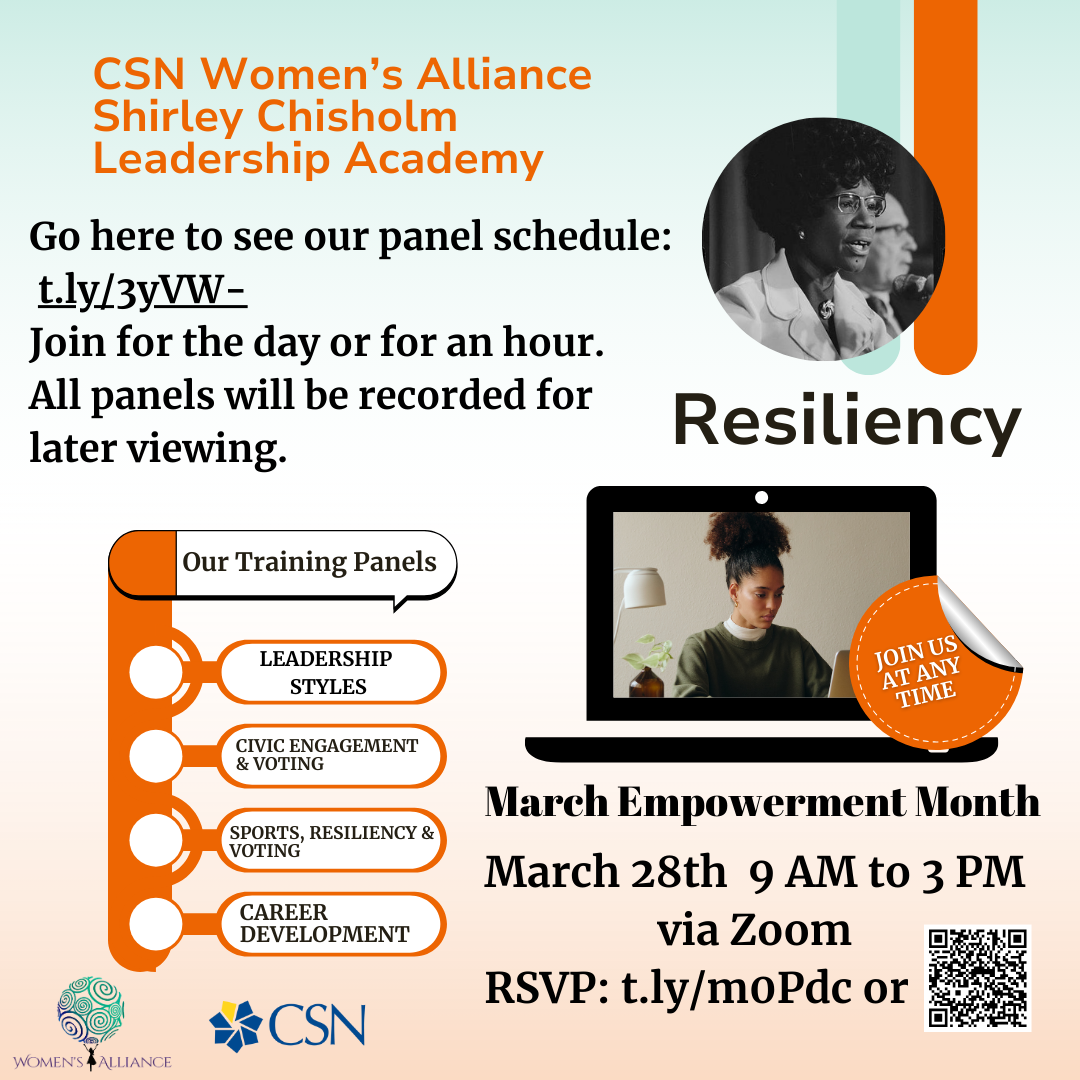
Lastly, please join me and the CSN Women’s Alliance on March 28th for our Shirley Chisholm Leadership Academy.  This virtual event will feature a series of panels between 9 AM and 3 PM.  A new panel will start at the top of each hour.  Don’t worry if you can’t spend the day with us; we’ll record each panel so you can watch later.

RSVP: t.ly/bhm7v

See the panel schedule here: Leadership Academy Panels

Thanks for being Nevadans with me,

 Sondra 

Vote Nevada is now qualified to receive donations through
Smith’s Inspiring Donations; you can read more about how to donate to Vote Nevada each time you use your Smith’s loyalty card here 
https://www.smithsfoodanddrug.com/i/community/smiths-inspiring-donations

Vote Nevada is a 501(c)(3) nonprofit civic engagement
organization.  Anyone can become a supporter by emailing 
info@vote-nevada.org;
we have no membership dues. You can now donate to Vote Nevada through
PayPal at  
https://www.paypal.com/donate/?hosted_button_id=L423L7FBMMBEA


Vote Nevada Update 3/8/2025

Vote Nevada Supporters,

 Women’s Empowerment Month update:

The CSN Women’s Alliance hosted a Breaking Barriers: Affordable Childcare Zoom meeting Friday.  We heard about some interesting new approaches to providing affordable childcare.  You can watch the recording here:  

https://vote-nevada.news/WA-Affordable-Childcare

Please also consider attending the CSN Women’s Alliance Shirley Chisholm Leadership Academy on March 28th.  We will be on Zoom from 9 AM to 3 PM, with a new panel starting at the top of every hour.  Resilient leadership is our theme this year.  You can RSVP through the link below and will receive one Zoom link you can use the whole day:

 https://us02web.zoom.us/meeting/register/u5OO29pwQe6ZvW999ioIpw#/registration

Legislative update: 

Week five of the legislative session just concluded.  A federal sword is still hanging over our state budget due to uncertainty in the courts and Congress, so most of the legislative bills heard up to now have been evaluated for their policy content.  Bills requiring money are waiting for news on federal funding, but legislative committees can only wait so long to address fiscal notes.

The regular session runs for just 120 calendar days, so bills must meet deadlines to stay viable. While some bills are deadline exempt and some that die may receive a reprieve and get a second life by leadership, in general, if a bill doesn’t advance fast enough, it’s dead for this session.

 You can view the 120-day calendar here https://www.leg.state.nv.us/Session/83rd2025/Docs/120-day_calendar.pdf

It’s possible we may need a brief special legislative session after the regular session if federal funds are still frozen, but hopefully that won’t be necessary because special sessions are expensive.

We’ve had one high-intensity joint-committee meeting of Health and Human Services on Wednesday, February 26th, to hear about the possible federal Medicaid cuts. 

You can watch the hearing here  https://sg001-harmony.sliq.net/00324/Harmony/en/PowerBrowser/PowerBrowserV2/20250226/-1/16779?mediaStartTime=20250226160442&mediaEndTime=20250226185711&viewMode=3&globalStreamId=4

 The information provided was shocking due to the high number of Nevadans on Medicaid. 

Medicaid is the health insurance program states offer with federal help for low-income and some disabled individuals.  Roughly 800,000 Nevadans are covered by Medicaid, and approximately 368,000 could lose coverage if federal budget cuts happen.  

 https://thenevadaindependent.com/article/nevada-republican-gov-lombardo-speaks-out-against-gops-proposed-medicaid-cuts

 https://www.kff.org/medicaid/issue-brief/eliminating-the-medicaid-expansion-federal-match-rate-state-by-state-estimates/

 This means we have thousands of Nevadans who are working full-time yet lack an employer-funded health insurance benefit and who also do not make enough to afford private health insurance.

 According to an article in The Nevada Current:

 “The number of employees of large companies and their dependents who are eligible for Medicaid has risen in recent years — from 261,151 in fiscal year 2019 to 376,597 in fiscal year 2023.”

 https://nevadacurrent.com/2024/01/24/amazon-walmart-remain-atop-list-of-companies-with-most-employees-on-nevada-medicaid/

The Medicaid expansion in 2012 under Governor Brian Sandoval helped many Nevadans, but now it is masking the fact that some major businesses and government agencies fail to offer health care coverage while paying their workers too little to purchase their own health insurance. 

From this fact, it’s logical to assume that many Nevadans are living close to the poverty line and can’t absorb even a slight economic shockwave.  If this is true, Nevada’s economy is not as strong as we assume. Teetering on the edge of a cliff makes a person unsafe, just as an economy teetering on the edge of a recession is unsafe.

Are there other signs that the economy is weak?

Coming out of the pandemic, Nevada’s economy was robust to the point where inflation made high prices a campaign issue in 2024.  The high cost of housing, food, gas, car insurance, childcare, and medical treatment were all topics of concern in last year’s election. 

Pandemic relief money spending provides additional evidence that many families felt the need to spend the extra money in their bank accounts in 2023 and 2024.  Financially stable households save surplus funds, while vulnerable families with unmet needs spend extra money.

 We heard policy ideas from candidates in both parties that would supposedly bring prices down or create new and better paying jobs.  Post-election, however, it appears federal Republicans are focused on tariffs and cutting federal jobs, while the Democrats are busy highlighting the cuts to federal subsidies that sustain programs such as Medicaid.

The choice for many Nevadans, therefore, continues to be either living on the edge of poverty with government support or without government support as they struggle with high prices for housing, food, gas, car insurance, childcare, and medical treatment.

Many groups and organizations are working to increase wages, provide more affordable services, and offer pathways to lucrative employment.  And these efforts help Nevadans in some areas, yet we lack a person or office that can execute a comprehensive workforce development plan that addresses systemic issues that keep people in poverty.

To create and implement a comprehensive workforce development plan that addresses systemic issues we need governing processes that can manage a heavy lift.  So, step one, if we want systems level change, we must communicate to elected leaders that this is a community supported goal, and then, second, we must determine legislative capacity to do the heavy lift required to change our workforce plan. 

To succeed, community members must come together, arrive at consensus on outcomes, and then measure those outcomes against the legislature’s capacity to address larger issues.  For instance, do we want our legislators to develop a workforce plan that can transition Nevadans into higher-wage skilled jobs, or would we like our legislature to create a position or consolidate administrative power into an existing office to oversee building a better and more comprehensive workforce ecosystem?  

It’s very likely people already exist in multiple offices, agencies, and boards who focus on discrete parts of workforce development, so we just need someone to help coordinate between those offices, boards, and agencies.

This happened in 2023 with Assembly Bill 37. Through the bill the legislature gave Nevada System of Higher Education funding and instructions to create a statewide mental and behavioral health workforce development program.   

With the capacity needed to do the job, the legislature instructed NSHE to implement a comprehensive workforce development plan.  Based on those instructions, the legislature now provides NSHE funding to coordinate with everyone working in the behavioral and mental health workforce space.

 An example of this process in the current legislative session is Assembly Bill 339, which creates the Office of Children’s Mental and Behavioral Health within the Office of the Director of the Department of Health and Human Services.  This office will coordinate the whole children’s mental and behavioral health system.

We need more of this type of thinking, so Vote Nevada is tracking workforce related bills this legislative session through our Nonpartisan Caucus.  After the legislative session ends, we plan to review which bills passed and ask which bills improved workforce development and good governance. 

The next step will be creating a citizens interim committee to discuss what we would need to create and implement a comprehensive workforce development plan.  The committee could make recommendations for bills in the 2027 legislative session or possible ballot questions in the 2026 election cycle.

 Thank you for being Nevadans with me,

 Sondra

Vote Nevada is now qualified to receive donations through Smith’s Inspiring Donations; you can read more about how to donate to Vote Nevada each time you use your Smith’s loyalty card here  https://www.smithsfoodanddrug.com/i/community/smiths-inspiring-donations

Vote Nevada is a 501(c)(3) nonprofit civic engagement organization.  Anyone can become a supporter by emailing info@vote-nevada.org; we have no membership dues. 

You can now donate to Vote Nevada through PayPal at  https://www.paypal.com/donate/?hosted_button_id=L423L7FBMMBEA


Vote Nevada Update: 2/23/2025

Vote Nevada Supporters,

We are heading into the fourth week of the legislative session and things are picking up, so, please be sure to check the scheduled meetings page for the bills to be heard this week. https://www.leg.state.nv.us/App/Calendar/A/

The Vote Nevada Nonpartisan Caucus is meeting tonight at 6 pm.  We are discussing the good governance bills and whether the legislation being proposed so far represents the needs of the people.  You can RSVP here to join us: https://vote-nevada.news/VN-Nonpartisan-Caucus-Meetings

In representative democracy, the people vote for fellow community members to represent their interests when writing bills and voting on various issues. Our current system of government at most levels is supposed to represent community needs. 

One weakness in this system, however, is that the two political parties have decided when a party member is elected, that the newly elected official should only represent the party’s interests and priorities.  The minority who voted for someone else are left out and lose their right to representation.  This causes frustration that can lead to extremism.

The other main weakness in this system, which seems to be growing worse with each election cycle, is the lack of direct communication between elected officials and the people they represent.

Due to uncompetitive races and campaigns that rely on ads, text messages, and mailers, many elected officials spend minimal time in their districts listening to broad swaths of their constituents.  And, for our legislators, due to the lack of staff during the interim, most community members have few, if any, opportunities to speak to them officially. 

This makes the legislative session the only time our legislators are “on the clock,” yet how often can you talk to legislators directly about what we want fixed?

Without town halls, true surveys, or other forms of authentic communication, we the people are often left out of our representative democracy.

We need governing processes that welcome more voices into the system. Showing up to speak in support or opposition of bills apparently isn’t possible for most voters, especially when opportunities to show up happen during the work day and can change from week to week.

So, tonight’s question is: Do we have bills that can make the government more representative of the people and our needs?

Please join us if you can, and thank you for being Nevadans with me,

Sondra

Vote Nevada is now qualified to receive donations through Smith’s Inspiring Donations; you can read more about how to donate to Vote Nevada each time you use your Smith’s loyalty card here  https://www.smithsfoodanddrug.com/i/community/smiths-inspiring-donations

Vote Nevada is a 501(c)(3) nonprofit civic engagement organization.  Anyone can become a supporter by emailing in…@vote-nevada.org; we have no membership dues. 

You can now donate to Vote Nevada through PayPal at  https://www.paypal.com/donate/?hosted_button_id=L423L7FBMMBEA