Vote Nevada Supporters,
We are now entering week 8 of the legislative session. The last day of the session is June 2nd. Legislators must start closing budgets on April 1st and per the Nevada Constitution the education budget must be funded first. Yet we are still unclear whether the federal government will fulfill its funding obligations to the states.
There is a standing court order requiring the Executive Branch to allocate funds passed by Congress and approved by the President, but we are still in a constitutional limbo.
Additionally, the continuing resolution just passed in the Senate will impact the larger federal budget process. If no federal funds or even reduced federal funds come to Nevada due to that resolution, our legislators and the Governor will be forced to make cuts to state programs.
In sum, representative government is failing at the national level as constitutional checks and balances are superseded by partisan politics. And that failure will have deep repercussions in the states.
It appears that the only current solution to changing what is happening federally is going to court, hoping, and waiting for the next election. But, even if the courts issue rulings directing the president to go back to Congress to ask for laws and funding allocations to be changed, it is possible the current Congress will affirm the President’s Executive Orders as law.
Similarly, if the President decides to just ignore the courts, it is unclear what will happen. Federal agency heads could be held in contempt of court, but the President is immune per the U.S. Supreme Court.
From a community perspective, the U.S. Constitution offers us no guide for what to do when the system of checks and balances breaks down. Electing new people in 2026 is one remedy being floated, but if we change the majority in the U.S. House of Representatives and the new majority demands the President stop doing something, but he ignores them, then what?
Do we wait until 2028 and hope our political system is responsive enough to elect people who will undertake a serious study of how to ensure checks and balances work? Right now, no one who is talking about the 2026 election or the 2028 election is mentioning constitutional changes that may need to happen.
The history behind the 14th and 25th Amendments are instructive.
We can’t assume that one party will control the government for forever and a day. We need some systemic fixes at the federal and possibly state level to make government work in ways that are legitimate and not subject to partisan influences.
Are the political parties even willing to adopt new processes that will make our government less susceptible to partisanship? Representative government is dependent on practices that ensure the people are being represented. The political parties, however, seem to have forgotten that they are not the people.
We have a similar problem at the state level. With each legislative session it is becoming more evident that our part-time partisan legislative system is not working. It’s not because legislators are part-time or because they only have 120 days to do the state’s business, it’s because the political parties have too much control over the inputs and outcomes.
When was the last time our elected officials spent time listening to community members to hear what we all want? It’s not happening during elections, instead, we are bombarded with campaign ads, mailers, and text messages that just attack the other side and beg for money. If you see a candidate, you’ll usually hear talking points. Once the election is over, legislators meet with their party leadership and interest groups, not constituents, to prepare for the session.
I live on the east side of Las Vegas. My legislators either had no contest in the primary or general election or are in between their first and second term, I seriously doubt either one knows what is most important for me.
During the session, how many weekend town halls are scheduled by legislators to let us know what happened that week?
Instead, we sit and watch while bills that address issues we are often unclear about move from one stage of the legislative process to the next. The Governor decides which bills to sign and which bills to veto. And then the next election cycle immediately begins with the parties attacking each other.
We have an interim legislative session where committees mirroring the legislature’s committee structure review issues predetermined by the parties and special interests. The public is not asked to weigh in on what we think or would like to see addressed in the next regular session.
It’s no wonder things always seem broken and unresponsive to community needs. Gerrymandering, closed primaries, and a growing number of uncontested races are all contributing to this problem. But these are symptoms of poor systems and processes that sideline the people.
At the federal level we need a solution to make checks and balances work and at the state level we need a system that can minimize partisanship in our state’s representative government.
Which brings me to this year’s Vote Nevada Summer of Civics 2025.
Once the legislative session ends, we will kick things off with our usual review of which bills were passed and signed by the Governor. This year we also have something new to debut, a Citizens Interim Committee experiment. Instead of only looking at issues, our interim committee will also look at systems and processes.
We often speak about different types of isms in American politics, but we rarely discuss our tradition of pragmatism. Pragmatism focuses on creating systems and processes that work. If we want certain outcomes, then what systems and processes can most effectively produce those outcomes?
So, our Citizens Interim Committee will use a pragmatic approach.
For instance, if we want a more responsive representative government, how do we ensure all community members are able to have their voices and concerns heard? Does voting and elections do this, or do we need to add something else?
Do we need a different process for developing our workforce? What do workers need to be successful and what system and/or process will lead to that success?
We are also reprising our workshops on running ballot questions and on how to run for nonpartisan offices as well as how to run as nonpartisan candidates in partisan races. I will send another email as we get closer to June 2nd detailing all the different ways to get involved.
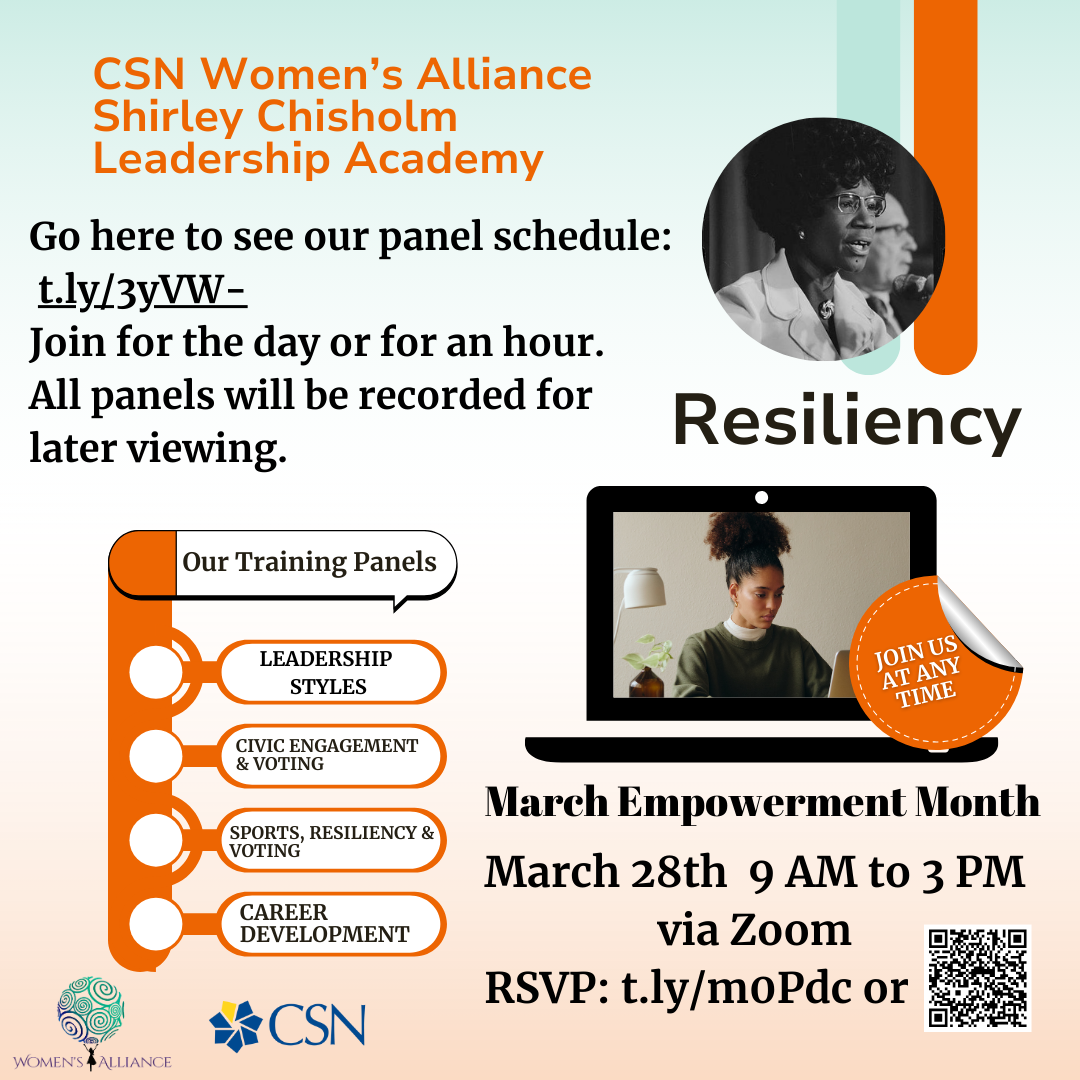
Lastly, please join me and the CSN Women’s Alliance on March 28th for our Shirley Chisholm Leadership Academy. This virtual event will feature a series of panels between 9 AM and 3 PM. A new panel will start at the top of each hour. Don’t worry if you can’t spend the day with us; we’ll record each panel so you can watch later.
RSVP: t.ly/bhm7v
See the panel schedule here: Leadership Academy Panels
Thanks for being Nevadans with me,
Sondra
Vote Nevada is now qualified to receive donations through
Smith’s Inspiring Donations; you can read more about how to donate to Vote Nevada each time you use your Smith’s loyalty card here https://www.smithsfoodanddrug.com/i/community/smiths-inspiring-donations
Vote Nevada is a 501(c)(3) nonprofit civic engagement
organization. Anyone can become a supporter by emailing info@vote-nevada.org;
we have no membership dues. You can now donate to Vote Nevada through
PayPal at https://www.paypal.com/donate/?hosted_button_id=L423L7FBMMBEA
 Vote Nevada