Vote Nevada Supporters,
Early voting ended Friday, and the turnout was only 11.7%.
https://www.nvsos.gov/sos/home/showpublisheddocument/13962/638534441932980082
Despite the low turnout, we are again inching toward 5,000 mail-in ballots that may go uncounted if not verified due to an issue with signatures. https://www.nvsos.gov/sos/home/showpublisheddocument/13962/638534441932980082
Please use ballot tracking if you vote via mail-in ballot to make sure you can verify your ballot if needed. It is unacceptable for approximately 5,000 voters to lose an important right every election.
https://nevada.ballottrax.net/voter/
Low voter turnout and mail-in ballot errors suggest we need more civics education and voter engagement. We must welcome every voter into our civic community and listen to their issue, including reasons for sitting out. Before I state my plan for engaging voters and non-voters alike, let me explain my approach.
When I started at the College of Southern Nevada in 2003, the demand for online learning exponentially increased semester after semester. Having classes available without needing to drive to campus on specific days and times opened higher education to many nontraditional students, especially women.
I took a community college position to help nontraditional students, so I devoted my early years as an educator to learning to teach online. However, after some time, student data started telling us something was wrong; online student failure rates grew alarmingly.
At that point, we could have said, “Well, these students must not be real students because they are not interested in education,” and have done nothing. Of course, we did not do this; as educators, we came together to investigate the higher failure rates.
We discovered three things. First, many online students were new to higher education and, therefore, were unfamiliar with college culture. Second, because these students were not on campus, they lacked easy access to on-campus student services, such as tutoring. Third, while these students were “digital natives,” they were unfamiliar with education technology.
From these findings, we developed recommendations for an action plan. Telling these students to take in-person classes was not a viable solution; they were online because they needed to be online. So, we needed to meet them where they were at.
To do this, we asked our administration to create virtual student services and worked with our E-Learning Office to communicate more clearly with students through our course design. We built student training resources for the e-learning software, and faculty studied best practices for teaching online. In sum, the faculty introspectively helped our students by being willing to do things differently.
Most importantly, we did not blame the students by dismissing their issues and concerns. We expected students to demonstrate personal responsibility, but we did so within an environment that provided the tools needed for success. Now, let’s discuss newly registered voters.
In 2019, Nevada adopted automatic voter registration via ballot initiative. Under this statutory change, anyone applying for an I.D. or driver’s license would automatically be registered to vote unless they opted out. The voter would also default to nonpartisan affiliation if she/he did not affirm a party selection. Because of this law, many more Nevadans are now registered to vote, yet voter turnout rates are not increasing in tandem.
We cannot accept just blaming voters for their lack of engagement. They know their registration status because they receive a sample and mail-in ballot every election, yet they are not voting. Why? Every state has different election laws and practices, so new Nevadans are unfamiliar with our governing systems and how we manage our elections. So, if we are going to register these new voters, we also must provide them basic civics and election information.
But how do we offer civics information to new voters without overwhelming them? Our primary election rules can be confusing and frustrating. I speak to new voters regularly, and it can take up to 30 minutes to explain our primary election practices and laws. California transplants, for example, arrive from an open primary system; they are particularly surprised to discover half our races are closed.
Vote Nevada offers a Summer of Civics program on civics education and engagement each year. So, this summer, we’ll focus on why voter turnout is so low and ways to address that problem. Voter education, community engagement, and democracy reform will all be themes. We need to provide information, but we also need to be open to change.
We are developing a survey tool to understand why voters opted not to vote in this primary election. Please help us distribute the tool as soon as it’s ready to roll.
In the meantime, please also RSVP for our Summer of Civics program. June and July events include research on turnout issues and education on ranked-choice voting so we can achieve better outcomes. August and September events will include all ballot questions for the November general election and the importance of down-ballot races.
Nevada’s election registrars and clerks will submit the final primary election results to the seventeen county commissions on June 21st. That is the day we will officially learn the election’s final results, so on June 22nd, from 9 to 10 a.m. via Zoom, Doug Goodman from Sparks will join us for some analysis.
Doug will offer an overview of the election data, including statewide turnout numbers, the races where candidates were elected to office, and the impact of nonpartisan voters in our primary races. You can RSVP here: https://us02web.zoom.us/meeting/register/tZEuf-igpjgpHd3SSTXKngiLXBgxhxdcatWB#/registration

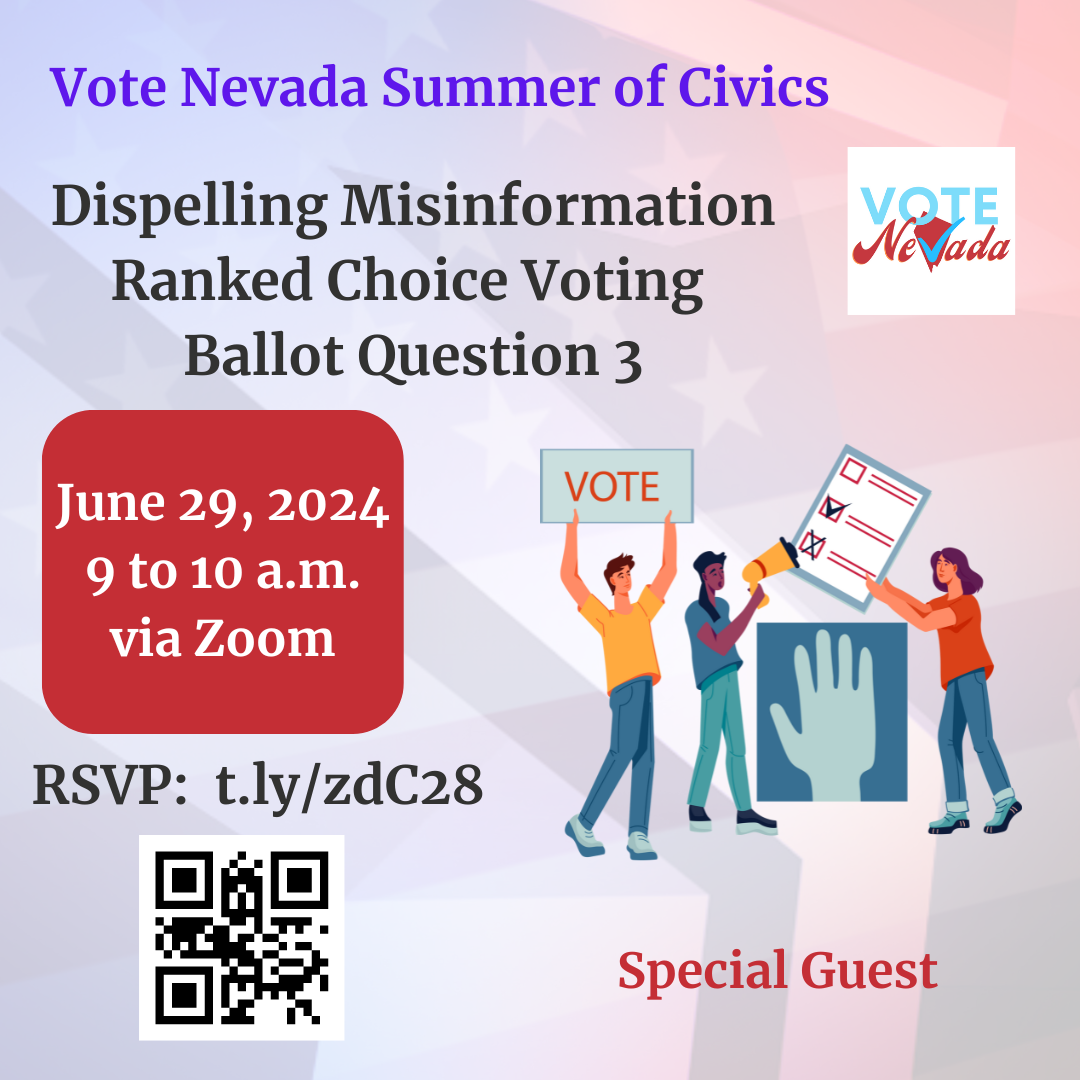
Our meeting on June 29th, from 9 to 10 a.m., via Zoom, will include special guest Walter Olson, a Senior Fellow at the Cato Institute. Walter has written about the legality of ranked-choice voting.
We will examine the misinformation about ranked-choice voting and the arguments for and against RCV. I especially want to put an end to the argument that ranked-choice voting is too confusing for communities of color. Anyone can learn when appropriately taught, but the responsibility is in the hands of the educator. You can RSVP here:
https://us02web.zoom.us/meeting/register/tZ0pd-2qqDIrGtGOM6FxuYPwjjAzMcraHQ5n#/registration
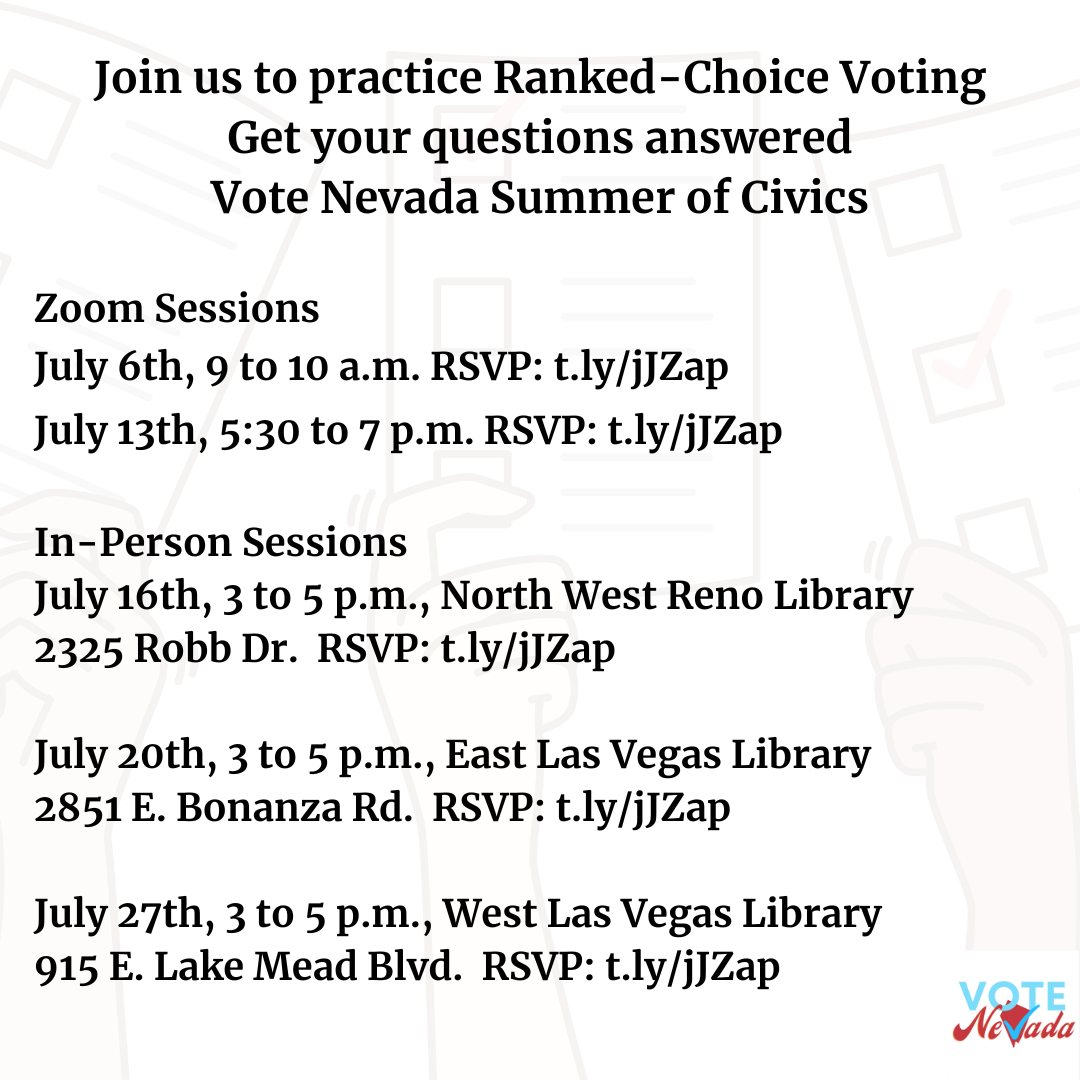
In July, we are hosting two virtual Zoom meetings to practice a ranked-choice voting election. The first is on July 6th, from 9 to 10:30 a.m., and the second is on July 13th, from 5:30 to 7 p.m.
We will also have three in-person events to practice ranked-choice voting. The first is on July 16th, from 3 to 5 p.m., at Reno’s North West Library. The second is July 20th from 3 to 5 p.m. at the East Las Vegas Library, and the third is July 27th from 3 to 5 p.m. at the West Las Vegas Library. You can RSVP for any of these events here: https://forms.gle/hUCimrPbwsUorGKf9
I will send more information about other events as we schedule more for August and September.
Please stay inside as much as possible over the next week as we face extreme heat very early this summer. It does not take long to dehydrate and slip into heat exhaustion.
Thank you for being Nevadans with me,
Sondra
Vote Nevada is now qualified to receive donations through Smith’s Inspiring Donations; you can read more about how to donate to Vote Nevada each time you use your Smith’s loyalty card here: https://www.smithsfoodanddrug.com/i/community/smiths-inspiring-donations
Vote Nevada is a 501(c)(3) nonprofit civic engagement organization. Anyone can become a supporter by emailing info@vote-nevada.org; we have no membership dues. You can now donate to Vote Nevada through PayPal at https://www.paypal.com/donate/?hosted_button_id=L423L7FBMMBEA
 Vote Nevada